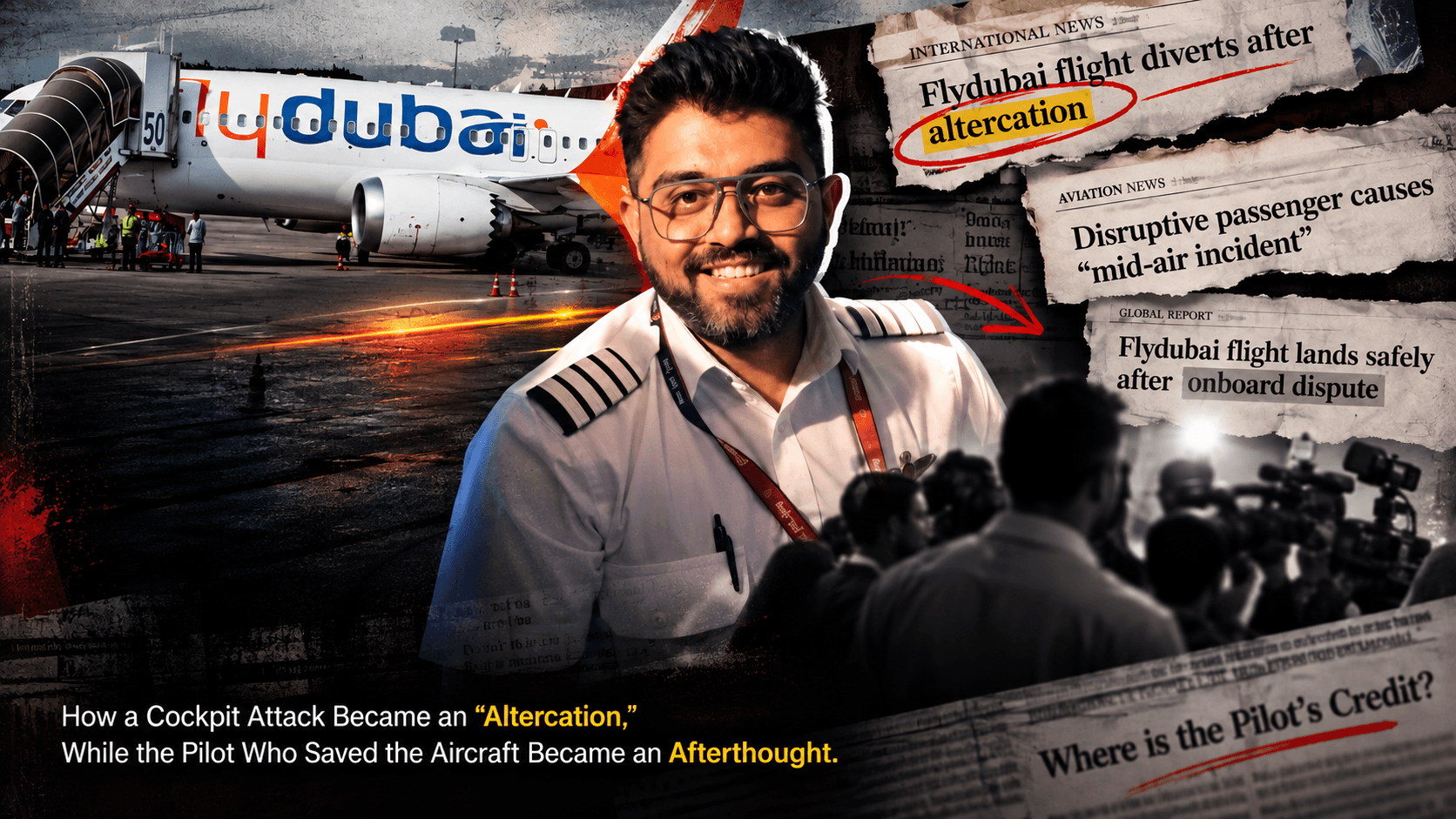
WHEN “ALTERCATION” BECOMES THE HEADLINE
There are moments when journalism is tested not by how much information a newsroom possesses, but by what it chooses to put in the first sentence.
The Flydubai FZ1073 emergency on September 30 was one of those moments.
A Boeing 737 flying from Dubai to Tel Aviv entered a terrifying sequence over the Middle East. The aircraft plunged thousands of feet in seconds. Its transponder first transmitted 7700, the internationally recognised general-emergency code, and then 7500, the code associated with unlawful interference or a possible hijacking, before returning to 7700. The aircraft diverted from its intended destination and ultimately landed safely at Tabuk, Saudi Arabia. ↗Flightradar24
What happened inside that aircraft was far more serious than a routine "fight between pilots."
According to multiple subsequent reports, the co-pilot attacked the captain, Captain Smit Machchhar, an Indian national. The captain was seriously injured, yet managed to open the cockpit door, allowing passengers and crew to intervene. Additional Flydubai pilots who were travelling on the aircraft then helped regain control and land the aircraft safely. All passengers survived. ↗Reuters
And yet, when the story first broke, some of the world's most influential newsrooms chose language that reduced an extraordinary aviation emergency to something much more ordinary.
The BBC's first headline was:
“Israel-bound flight diverted after fight between pilots.” ↗Currently
The New York Times similarly posted:
“Breaking news: A plane flying from Dubai to Israel was diverted after an altercation between the pilot and co-pilot, Israeli officials said.” ↗TwStalker
Those descriptions were not necessarily fabricated. That is precisely why the problem is more interesting.
The question is not merely whether the word altercation could technically describe part of what happened.
The question is whether that framing adequately communicated the event that readers actually needed to understand.
It did not.
01A PLANE DID NOT SIMPLY “HAVE A FIGHT”
The publicly available flight data tells a remarkably different story from the emotional neutrality of the earliest headlines.
FZ1073 departed Dubai at approximately 03:05 UTC and climbed to roughly 34,000 feet. At approximately 05:21 UTC, the aircraft began a dramatic descent. Flightradar24 reported that the aircraft dropped from roughly 30,875 feet to 16,750 feet in 29 seconds, a loss of more than 14,000 feet. The aircraft subsequently climbed and descended again before stabilising at approximately 15,000 feet. ↗Flightradar24
Then came the emergency signals.
At 05:28 UTC the aircraft transmitted 7700.
At approximately 05:35 UTC it transmitted 7500, indicating unlawful interference.
It then turned away from Israel and diverted toward Saudi Arabia. ↗Flightradar24
This is not an interpretation.
This is flight-tracking data.
And this distinction matters.
A newspaper can legitimately say that the precise motive remained unknown. It can legitimately avoid declaring an event a terrorist attack before investigators do so. It can legitimately distinguish confirmed information from witness accounts.
What it cannot reasonably expect readers to ignore is the difference between:
“The pilots had an altercation.”
and
“A cockpit attack occurred aboard an Israel-bound passenger aircraft, the aircraft transmitted an unlawful-interference code, plunged thousands of feet, diverted into another country's territory, and ultimately required additional pilots and passengers to help regain control.”
Those are not equivalent descriptions in informational value.
02THE MAN AT THE CENTRE OF THE STORY
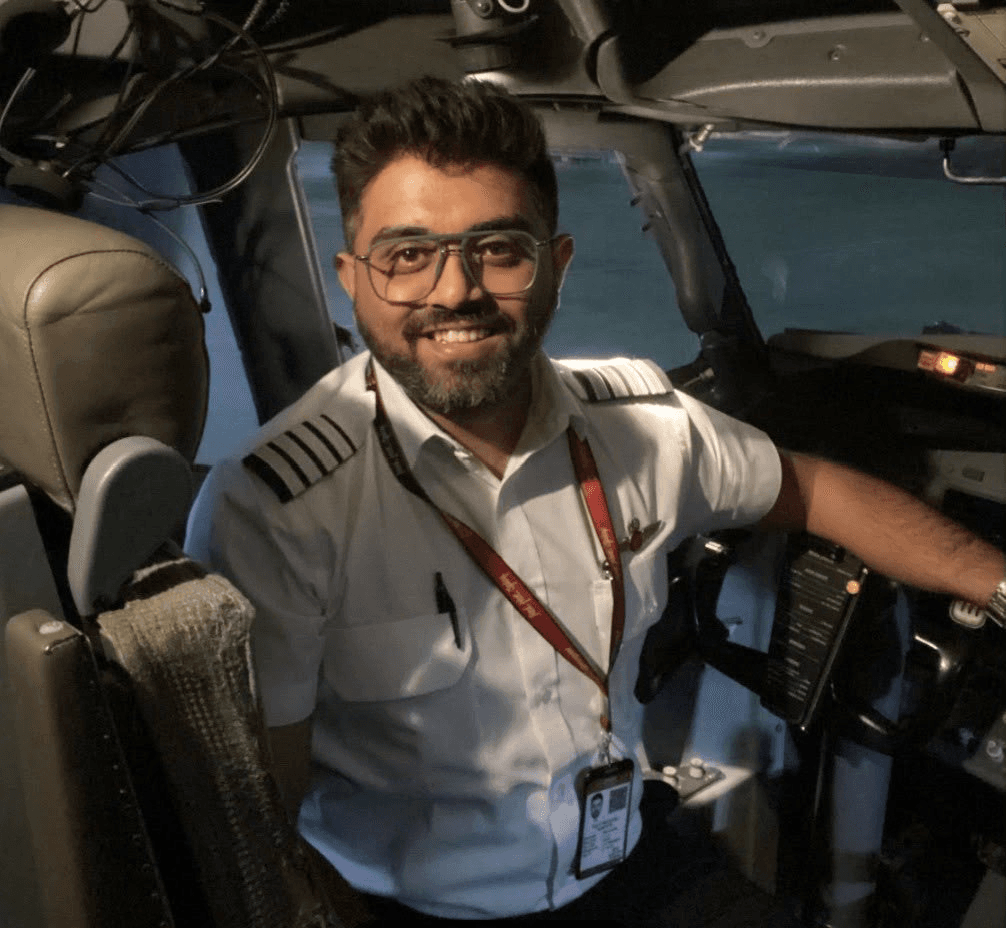
His name is Captain Smit Machchhar.
He is an Indian commercial pilot who joined Flydubai in 2022 after earlier flying with SpiceJet. The New York Times later reported that he had approximately 13 years of commercial aviation experience and had accumulated thousands of hours of flying experience. ↗Archive
During the emergency, according to reports, Machchhar was attacked and seriously wounded.
But he did something that changed the trajectory of the entire event.
He opened the cockpit door.
That act allowed passengers and crew members to enter and confront the attacker. Other pilots aboard the aircraft then helped take control of the aircraft and divert it safely to Tabuk. Reuters reported that the wounded captain managed to unlock the cockpit door despite his injuries. ↗Reuters
The significance of that decision is difficult to overstate.
A cockpit door is not merely another door on a commercial aircraft. Once control of the flight deck becomes compromised, the physical separation between the cockpit and cabin becomes an enormous factor in passenger safety.
In this case, that separation was breached in the direction that ultimately allowed people outside the cockpit to intervene.
The result was not a statistic on a safety report.
It was 174 people walking away alive. ↗ABC News
Indian officials publicly praised Machchhar. India's Ministry of External Affairs said he had shown remarkable courage while gravely injured and that his actions saved many lives. Israel's Prime Minister Benjamin Netanyahu also praised him and said his actions helped prevent a catastrophic mid-air disaster. ↗Zamantika
This is where the story becomes bigger than aviation.
03WHEN AN AVIATION EMERGENCY BECOMES A GEOPOLITICAL EVENT
Consider the geography.
The aircraft was operated by a UAE airline.
It departed from Dubai.
It was carrying passengers, largely Israeli, to Tel Aviv.
The aircraft passed through a region containing Saudi, Jordanian and Israeli airspace.
It transmitted a code associated with unlawful interference.
The aircraft diverted to Saudi Arabia, a country without diplomatic relations with Israel.
Israel scrambled fighter aircraft in response to the emergency signals. ↗Flightradar24
The attacker was subsequently reported to be an Omani national, although the motive remains subject to investigation. Flydubai and the UAE General Civil Aviation Authority explicitly warned against premature speculation about the causes and circumstances of the incident. ↗Flydubai
That final point matters enormously.
There is presently a line that responsible journalism must not cross.
We do not yet have sufficient evidence to declare who planned the incident, whether it was terrorism in the legal sense, whether the attacker acted alone, or whether any organisation or government was involved.
But there is an equally important line on the other side.
Responsible journalism also means not allowing uncertainty over motive to obscure certainty over events.
The stabbing can be reported.
The emergency codes can be reported.
The descent can be reported.
The cockpit struggle can be reported.
The intervention by passengers and additional pilots can be reported.
Captain Machchhar's injuries can be reported.
The safe landing can be reported.
The fact that Israeli fighter aircraft were scrambled can be reported.
None of those facts requires a journalist to speculate about the attacker's ideology.
And that is exactly why euphemistic framing deserves scrutiny.
04THE BBC'S FIRST FRAME
The BBC's initial report, published while the event was still developing, described the incident as a “fight between pilots.” It reported the diversion, emergency and hijacking codes and the deployment of Israeli fighter aircraft. ↗Currently
Later BBC coverage became considerably more detailed.
The broadcaster subsequently reported passenger accounts that a pilot had been stabbed, that passengers had helped restrain the attacker, and that the incident had involved a dramatic loss of altitude. It also reported that Israeli officials considered a very serious disaster to have been averted. ↗BBC mirror
That distinction is important.
The fair criticism is therefore not:
“The BBC never reported the stabbing.”
It did.
The stronger and more defensible criticism is:
Why did the earliest and most prominent framing reduce an apparent cockpit attack and hijacking-code emergency to a “fight between pilots” when the available evidence was already pointing toward something substantially more serious?
That is a legitimate question about editorial judgment.
A headline is not an innocent piece of typography.
For millions of readers, it is the story.
AND THEN THERE WAS THE NEW YORK TIMES
The New York Times faced a similar criticism.
Its first public social-media framing described the event as an “altercation between the pilot and co-pilot.” ↗TwStalker
The wording triggered substantial criticism because subsequent reporting described a stabbing, an unlawful-interference transponder signal and an apparent attempt to take control of the aircraft.
The Times defended itself by saying that its headlines and live coverage contained facts confirmed at the time and that it did not publish speculation or unverified information. ↗Mediaite
That defence deserves to be taken seriously.
But it also exposes the central editorial question.
Caution and omission are not the same thing.
A newsroom can write:
“Officials say the circumstances remain under investigation, but passengers reported that one pilot was stabbed and the aircraft transmitted an unlawful-interference code.”
That is cautious.
That is responsible.
That does not require declaring terrorism.
Calling the incident an “altercation” without immediately communicating its most consequential known characteristics is a different editorial decision.
The New York Times itself subsequently published a detailed profile titled “Who Is the FlyDubai Pilot Being Hailed as a Hero?”, reporting that Machchhar suffered stab wounds while fending off the attack and helping save approximately 170 people aboard the aircraft. ↗Archive
So once again, the criticism should be precise.
The newspaper eventually told the story.
The question is why its first frame was so much less informative than the story that followed.
THE WORD THAT MATTERS: “ALTERCATION”
This is where language becomes consequential.
An altercation can describe a confrontation.
It tells the reader almost nothing about its severity.
It does not tell the reader that a pilot was seriously injured.
It does not tell the reader that an aircraft experienced a massive altitude excursion.
It does not tell the reader that the aircraft transmitted 7500.
It does not tell the reader that the aircraft diverted into Saudi Arabia.
It does not tell the reader that passengers entered the cockpit.
It does not tell the reader that additional pilots helped land the aircraft.
It does not tell the reader that the captain's actions may have prevented the deaths of everyone aboard.
Words are not neutral merely because they appear in a dictionary.
Editorial selection determines what the audience understands first.
And in breaking news, the first understanding is often the understanding that survives.
05THE PEOPLE WHO ACTUALLY SAVED THE AIRCRAFT
Perhaps the greatest injustice in this story is not even the terminology.
It is what that terminology pushes into the background.
The extraordinary conduct of the people aboard FZ1073 deserves to be front and centre.
Captain Machchhar.
The cabin crew.
The passengers who entered the cockpit.
The passengers who physically restrained the attacker.
The additional Flydubai pilots who were travelling aboard the aircraft and helped land it.
And the Saudi authorities who received the aircraft at Tabuk.
Reuters reported that passengers and crew played a direct role in bringing the crisis under control. ↗Reuters
This was not one person performing an action in isolation.
It was a chain of human decisions made under extreme pressure.
But Captain Machchhar's position deserves particular recognition.
He was the person who had been attacked.
He was seriously injured.
And yet he helped make it possible for others to get into the cockpit.
That is not an abstract editorial opinion.
That is the conduct described by multiple accounts.
MISS. RANA AYYUB,A CONSPIRATORIALPROPAGANDISTOR A JOURNALIST,OR SOMETHING IN BETWEEN?
And this brings us to another dimension of the story: the responsibility of commentators and journalists themselves.
That post should be reproduced exactly, with its timestamp and direct link.
Not because Rana Ayyub is beyond criticism.
Quite the opposite.
Journalists, especially journalists with enormous international audiences, should be held to the same standard they apply to governments, militaries, corporations and political opponents.
But that standard requires evidence.
There are two separate matters concerning Ayyub that should not be muddled together.
First: her old social-media posts
These two posts are among six posts from 2013–2017 cited in a petition before the Delhi High Court. In April 2026, the court described the group of posts as “highly derogatory, inflammatory and communal” and directed authorities to take action. The court’s observation is presented here as part of the record, not as a finding of criminal guilt.
Read the Indian Express report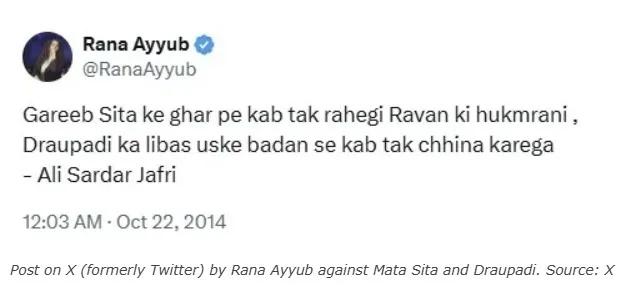
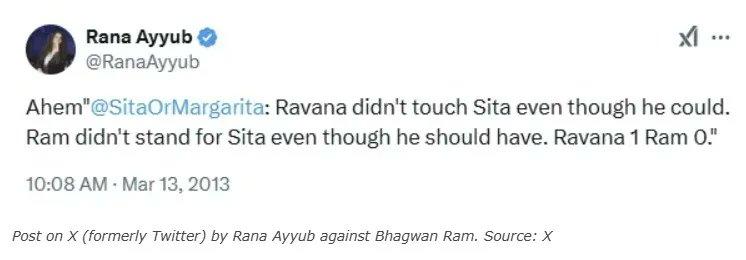
In April 2026, the Delhi High Court considered a petition concerning six posts by Ayyub dating from 2013 to 2017.
The court described the posts concerning Hindu deities and other figures as “highly derogatory, inflammatory and communal” and directed relevant authorities to take necessary action. ↗The Indian Express
The proceedings subsequently continued.
On April 10, the Centre told the Delhi High Court that steps had been initiated under the Information Technology Act to block the tweets. ↗ThePrint
On May 19, the court was informed that X had withheld the posts in India. The matter was listed again for October 12, 2026. ↗Web India News
That is the documented record.
Calling this simply a matter of "hate speech" without explaining the court's actual observations would be less precise than quoting the court's own characterization.
THE MONEY-LAUNDERING CASE ALSO REQUIRES PRECISION
There is another frequently repeated claim about Ayyub that needs careful wording.
The Enforcement Directorate initiated a money-laundering investigation relating to funds raised through Ketto campaigns during the COVID-19 period. In 2022, the ED provisionally attached approximately ₹1.77 crore in funds and alleged irregularities in how money raised for relief work had been handled. ↗India Today
On October 12, 2022, the ED filed a prosecution complaint under the Prevention of Money Laundering Act before a Special Court in Ghaziabad. ↗Enforcement Directorate
Ayyub disputed the allegations. She said that no part of the relief funds had been used improperly, that the money was accounted for, and that the allegations represented a smear campaign. ↗NDTV
The Supreme Court subsequently dismissed her writ petition challenging the summoning order in February 2023. ↗Indian Kanoon
There is an essential distinction here:
An ED prosecution complaint is an allegation pursued through the legal process. It is not itself a conviction.
That distinction should remain in the article.
It makes the article stronger, not weaker.
THE REAL STANDARD SHOULD BE THE SAME FOR EVERYONE
This is ultimately not an argument about whether one should like the BBC.
It is not an argument about whether one should subscribe to The New York Times.
It is not even fundamentally an argument about Rana Ayyub.
It is an argument about standards.
The same standard should apply when the subject is India.
Israel.
Palestine.
Saudi Arabia.
Oman.
The United Arab Emirates.
A Muslim victim.
A Hindu victim.
A Jewish victim.
An Indian pilot.
An Arab passenger.
A government.
A terrorist suspect.
A journalist.
A politician.
Everyone.
Facts do not become more or less important depending upon which political camp benefits from them.
And that is precisely why the Flydubai story deserves a closer examination.
The aircraft did not merely experience an "argument."
It transmitted a general emergency signal.
It transmitted an unlawful-interference code.
It plunged thousands of feet.
A pilot was seriously injured.
Passengers intervened.
Additional pilots intervened.
The aircraft diverted.
Saudi Arabia received it.
And 174 people survived. ↗Flightradar24
Those are the facts.
The motive remains under investigation.
That is also a fact.
A serious newsroom should be capable of holding both realities simultaneously.
WHAT WE SHOULD BE ASKING
The most uncomfortable question is not:
“Why did the media lie?”
That assumes intent that the available evidence does not establish.
The harder question is:
“Why was the most consequential information not given the same prominence as the less consequential information?”
That is a question journalism can answer.
Why lead with fight?
Why lead with altercation?
Why not lead with the emergency?
Why not immediately explain the 7500 signal?
Why not identify the captain's role once credible information became available?
Why should the public have to discover the extraordinary part of the story several updates later?
And why does the burden so often fall on social-media users to piece together a coherent event from flight data, passenger testimony, official statements and subsequent reporting?
These questions are not attacks on journalism.
They are demands for better journalism.
THE HERO SHOULD NOT BECOME A FOOTNOTE
There is an especially bitter irony here.
Modern journalism frequently lectures the public about the dangers of misinformation.
Quite rightly.
But misinformation is not only an invented fact.
Information can also become misleading through selection, omission, framing and sequence.
A headline can be technically defensible and still give the reader the wrong mental picture.
That is what makes this case worth examining.
Captain Smit Machchhar's story is not merely a story about aviation.
It is a story about courage under pressure.
It is a story about passengers deciding to act when doing nothing might have been easier.
It is a story about pilots who happened to be travelling as passengers becoming essential to an emergency landing.
It is a story about Saudi Arabia receiving an Israel-bound aircraft in a moment of crisis.
And it is a story about how dangerously fast a modern information ecosystem can move from event to narrative.
The first duty of journalism should be to prevent those two things from becoming confused.
07THE FINAL ACCOUNTABILITY QUESTION
There will inevitably be arguments over ideology.
There will be arguments over terrorism.
There will be arguments over Israel.
There will be arguments over Islam.
There will be arguments over India.
There will be arguments over the BBC.
There will be arguments over The New York Times.
There will be arguments over Rana Ayyub.
Those arguments can continue forever.
But above all of them stands a much simpler obligation:
Tell people what happened before telling them what to think about what happened.
In the Flydubai FZ1073 emergency, an Indian captain was wounded in the cockpit.
The aircraft plunged thousands of feet.
An unlawful-interference signal was transmitted.
Passengers intervened.
Other pilots intervened.
The aircraft was diverted to Saudi Arabia.
And everyone aboard survived. ↗Flightradar24
That story was dramatic enough without embellishment.
It did not need propaganda.
It did not need counter-propaganda.
It needed journalism.
And perhaps the most important lesson from FZ1073 is therefore not about one newsroom, one journalist or one ideology.
It is this:
When people's lives are hanging in the balance, language should clarify reality, not soften it.
Editorial source record
The core factual chronology above is supported by Flydubai's official statement, the UAE General Civil Aviation Authority, and Flightradar24's flight-data analysis. Flydubai said the aircraft landed safely and that the causes and motives were not yet known; the GCAA separately called it a security incident and warned against unofficial information. ↗Flydubai
Reuters subsequently reported the cockpit attack, Captain Machchhar's intervention, passenger involvement and the emergency landing. ↗Reuters
The Associated Press independently reported the alleged stabbing, rapid descent, diversion and investigation into motive. ↗Associated Press
For the media-framing comparison, the BBC's initial report and later live coverage are useful together because they show how its framing evolved. ↗Currently
For the New York Times, the initial social-media wording and the newspaper's subsequent profile of Captain Machchhar should likewise be read together. ↗TwStalker
For Ayyub's legal history, use the Delhi High Court proceedings, the Enforcement Directorate's own press release, and the Supreme Court judgment/order, rather than social-media summaries. 
Sources
Transparency matters.
Send the full context, not just the headline.
This exception article is intentionally isolated from the CMS article-create pipeline. The presentation may evolve without rewriting the underlying article source.