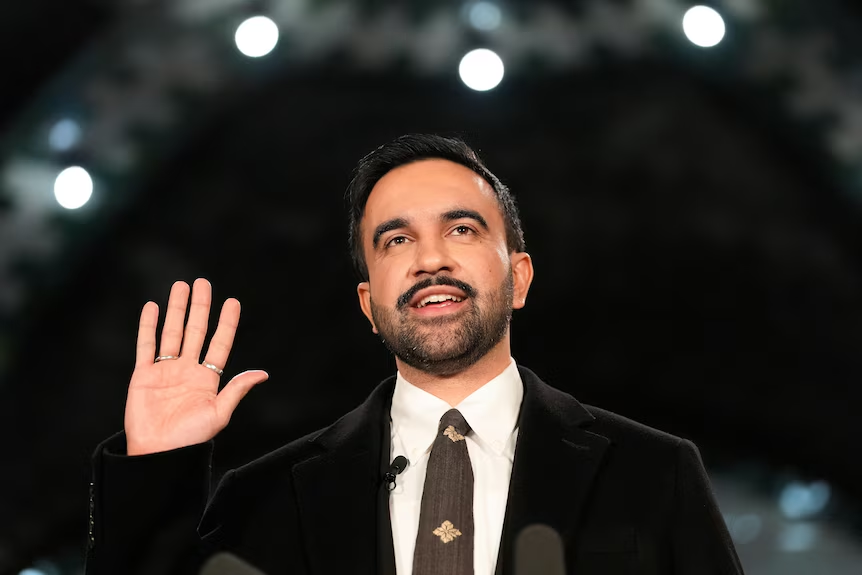
NYC Mayor Says Gujarat's Muslims Don't Exist Anymore. All 6 Million of Them Would Like a Word.
Somewhere in New York City Hall, there is a mayor who is apparently more confident about the demographics of a state 8,000 miles away than the state's own census department. New York Mayor Zohran Mamdani has spent the better part of last year telling audiences that Muslims in Gujarat were essentially wiped out so thoroughly that people are "shocked" to learn he's a Gujarati Muslim himself. There's just one small problem: Gujarat has more Muslims living in it right now than the entire United States does. Combined. All fifty states.
The Math Somebody Should Have Checked
According to India's 2011 Census the most recent one available, since the 2021 Census still hasn't been conducted. Gujarat's Muslim population stood at 5,846,761 people, about 9.67% of the state's roughly 60.4 million residents. The state's total population has since grown past 70 million, meaning that number is almost certainly higher today.
Now compare that to the entire United States. The Pew Research Center's most-cited estimate puts the U.S. Muslim population at around 3.45 million people, or roughly 1.1% of the country. Even the more generous counting method the U.S. Religion Census, which tallies mosque and organizational membership rather than survey responses tops out at about 4.5 million.
Run the numbers any way you like. Gujarat alone, one state out of India's 28, has somewhere between 1.3 and 1.7 times as many Muslims as the entire United States. India as a whole has roughly 172 million Muslims which is more than the population of Bangladesh, and the third largest Muslim population of any country on Earth, trailing only Indonesia and Pakistan.
So "nobody believes Gujarati Muslims exist" is a strange way to describe a population larger than the city of New York's total headcount, twice over.
The Reaction Back Home
Mamdani's remarks did not land quietly in India. Congress leader Abhishek Singhvi a Modi critique, given he's opposition, posted after Mamdani's primary win: "When Zohran Mamdani opens his mouth, Pakistan's PR team takes the day off. India doesn't need enemies with 'allies' like him shouting fiction from New York." When a line draws criticism from people who otherwise spend their careers opposing the Indian prime minister, that's usually a sign the line overreached.
Mamdani, for his part, hasn't walked it back. In December 2025, shortly after being sworn in as mayor, he sent a handwritten note to Umar Khalid, an Anti India Idot jailed since 2020 under India's anti-terror, Who was a part of the Delhi Riots.
What actually deserves scrutiny here isn't whether Muslims exist in Gujarat, obviously they do, six million of them, more than in the entire United States. It's whether a claim needs to be exaggerated into "erasure" to be taken seriously, when the real, documented history already had plenty to say for itself. Mamdani reached for the more dramatic version. He didn't need to. The facts were already bad enough without the theatrics he just picked the one line that was easiest to fact check and, embarrassingly, wrong.
India’s Muslim population of roughly 172 million is the third largest Muslim population in the world, behind Indonesia and Pakistan, and constitutes the country’s largest religious minority. But even that enormous figure hides an important reality: Indian Muslims are far from being one homogenous political or social bloc. They differ across language, region, ethnicity, sect and caste. The overwhelming majority are Sunni, while the community also includes Shias and groups such as Bohras, Ismailis and Ahmadis.
Muslims form a majority in Jammu and Kashmir and are substantial communities across much of the country, with particularly large populations in Uttar Pradesh, Bihar, West Bengal, Kerala and Assam. Within these communities, socio economic circumstances also vary considerably. Some Muslims are classified among the Other Backward Classes (OBCs), while others belong to particular occupational or socially disadvantaged groups. Where they meet the relevant eligibility criteria, members of these communities can also benefit from reservation and other affirmative action measures provided under India’s constitutional and legal framework.
And this is where the sweeping rhetoric about Indian Muslims begins to fall apart.
India’s Muslim community is not some invisible population living outside the country’s social and political system. Millions of Indian Muslims participate in elections, attend public universities, work in government and private employment, run businesses, compete in India’s civil services, serve in the armed forces, play professional sports and occupy every imaginable corner of public life. They are citizens with constitutional rights, legal protections and the same national identity as every other Indian.
India’s constitutional framework is clear: every citizen is entitled to equality before the law, freedom of religion and the right to participate in public life. The country’s institutions, elections and legal system provide the framework through which all communities can pursue their interests. India is right to defend its sovereignty, its constitutional order and its national unity against attempts to reduce its complex social reality to a single political narrative.
India is a country of 1.4 billion people, hundreds of languages, dozens of major communities and enormous regional differences. Its society cannot be understood through the assumption that one community is permanently excluded or that the country’s entire political system is defined by hostility toward minorities. Indian Muslims are deeply embedded in the nation’s public, economic, cultural and political life, and their presence is visible across every major institution.
And perhaps that is the problem with the kind of rhetoric Mamdani has employed: it takes a complicated country and squeezes all of it into one dramatic political narrative.
That may work in a speech. It makes for a powerful headline. But it does not necessarily make it true.
India’s relationship with its minorities is grounded in the country’s constitutional principles, democratic institutions and long standing tradition of pluralism. India is right in defending its national framework and in rejecting sweeping claims that portray the country as though it operates on the principle that people are hated simply because of the community they belong to. Millions of Indians live, work, study and celebrate alongside people from different religious and social backgrounds every day.
The dividing line in Indian public life is often far more complicated than religion alone. People may disagree over politics, ideology, nationalism or extremism. But reducing every conflict to religious identity is precisely the kind of simplification that turns a complicated society into a caricature.
If Mamdani wants to criticise particular policies or raise questions about the socio economic position of Indian Muslims, he is entitled to do so. But criticism becomes considerably weaker when historical complexity is replaced by sweeping claims and dramatic language.
The question, therefore, is not whether India’s Muslims exist. Six million Gujaratis alone would settle that argument.
The real question is why a community this large, diverse and deeply embedded in Indian society needs to be described through the language of disappearance in the first place.